Golden Retriever Dog Breed: Temperament, Health & Care Guide
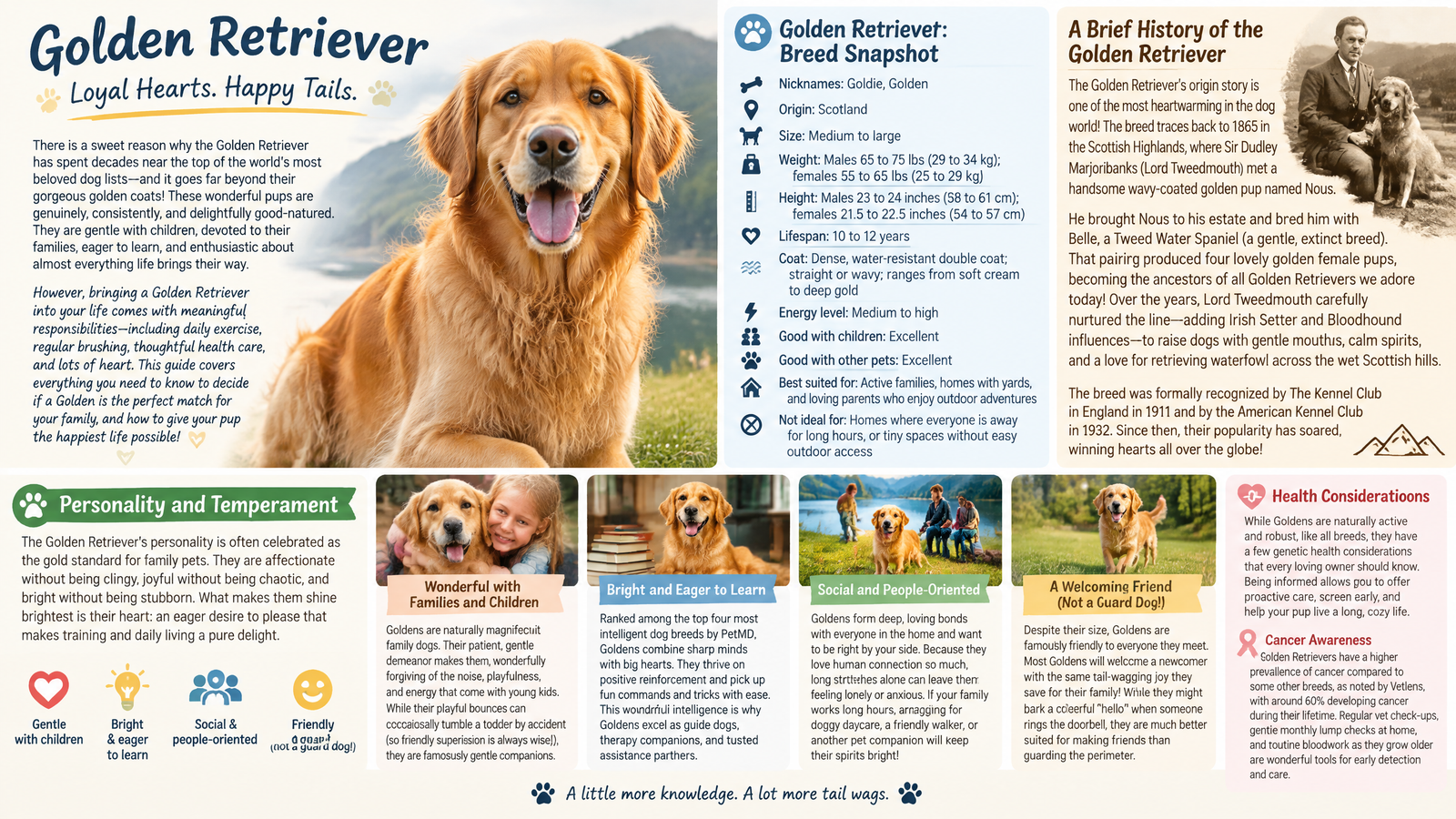
People get Goldens because the temperament is usually what the postcard says: friendly, trainable, soft with kids. The part that shows up later is hair on every stair, a dog who falls apart if the house is empty all day, and a vet file that is not always boring.
This is a breed overview, not a promise about the puppy in front of you.
Snapshot
Also called Goldie or Golden
Origin: Scotland, developed as a gundog
Size: males often 65 to 75 lb and 23 to 24 inches; females often 55 to 65 lb and 21.5 to 22.5 inches
Lifespan: commonly 10 to 12 years
Coat: double coat, cream to gold, straight or wavy
Energy: medium-high, especially before age three
Kids and other pets: usually good, with supervision
Poor fit: a house that is empty from breakfast to dinner and a person who hates shedding
Where the breed came from
The Kennel Club story starts in the Scottish Highlands in the 1860s. Lord Tweedmouth (Dudley Marjoribanks) kept a yellow retriever named Nous and bred him to a Tweed Water Spaniel named Belle. Later crosses brought in setter and bloodhound. The point of the program was a soft mouth and a dog who would work in cold water, not a sofa ornament.
England recognized the breed in 1911. The AKC followed in 1932. The pet version and the field version have drifted apart. If you want a calmer house dog, meet the parents. A field-bred Golden can be a wonderful dog and a terrible surprise in an apartment.
Temperament, with the annoying parts included
Most Goldens want to be in the room. That is the trait people buy, and the trait that becomes barking or chewing when nobody is home. A walker or a midday visit is not a luxury for this breed if your workday is long.
They are usually easy to train because food and praise land. They are also mouthy as puppies, and the tail clears coffee tables. “Good with children” still means you teach the kids not to climb on a sleeping dog. A bounce that is friendly can knock over a toddler.
They make poor guard dogs. A doorbell bark is a greeting. If you need a dog who is suspicious of strangers, look elsewhere.
PetMD and similar reviews rank them high on biddability, which is why they show up as guides and therapy dogs. Those jobs are selected and trained. A pet Golden still needs a class, not just a kind household.
Health
Ask about hips, elbows, eyes, and hearts before you take a puppy. Those are the standard screens. Cancer is the one that worries owners later. A long-running Morris Animal Foundation study of Goldens has reported that about 60 percent of the dogs in that group died of cancer, which is higher than many other breeds. That number is not a forecast for your dog. It is a reason to learn what a new lump feels like and not to skip yearly exams.
Hip and elbow dysplasia show up often enough that the Orthopedic Foundation for Animals publishes breed stats. Keep puppies on a large-breed diet, skip forced jogging until growth plates close, and do not let a Golden get fat. Extra weight is the risk you can actually move.
Hypothyroidism shows up as weight gain, dull coat, and a dog who seems older than they are. A blood test sorts it out. Ear infections are the everyday one: floppy ears plus swimming. Dry the ear flap after water. Do not go digging with a cotton swab.
Insurance is worth pricing while the dog is young, before a diagnosis makes it useless.
Exercise and coat
Adult Goldens usually need an hour or two of something, split up. Fetch, a hike, swimming if the water is safe. Swimming is easier on joints than pavement, and it soaks the coat to the skin. Rinse chlorine or salt, then dry the ears.
Puppies under 18 months do better with short play on grass than with a five-mile run. A sniff walk counts. It spends the brain without pounding the shoulders.
Brush several times a week, daily when the coat blows in spring and fall. A slicker and an undercoat rake beat a pretty brush that only skims the top. Baths every month or two, unless they found something dead. Trim the feathering behind the legs if it mats. Nails every few weeks. Teeth as often as you can stand.
Grooming is also when you find the lump or the hot spot. If the dog goes still and tight while you brush, stop and read that as discomfort, not drama. The body language notes help here.
Should you get one
Yes, if you like a dog in the kitchen, can live with hair, and will do something outside most days. No, if the appeal is the color and the plan is a crate from 8 to 6 with a weekend hike as compensation.
Meet an adult before you decide. Puppies hide the shedding and the separation piece. The adult on the couch at noon is the dog you are actually buying.

 People get Goldens because the temperament is usually what the postcard says: friendly, trainable, soft with kids. The part that shows up later is hair on every stair, a dog who falls apart if the house is empty all day, and a vet file that is not always boring.
This is a breed overview, not a promise about the puppy in front of you.
People get Goldens because the temperament is usually what the postcard says: friendly, trainable, soft with kids. The part that shows up later is hair on every stair, a dog who falls apart if the house is empty all day, and a vet file that is not always boring.
This is a breed overview, not a promise about the puppy in front of you.