Sniff Walks & Decompression Walks: What They Are and Why Your Pups Will Love Them
Most neighborhood walks are a compromise. You have a route, a time, and a dog who keeps stopping at the same lamp post. Sniff walks flip that. You still hold the leash. The dog picks the pauses.
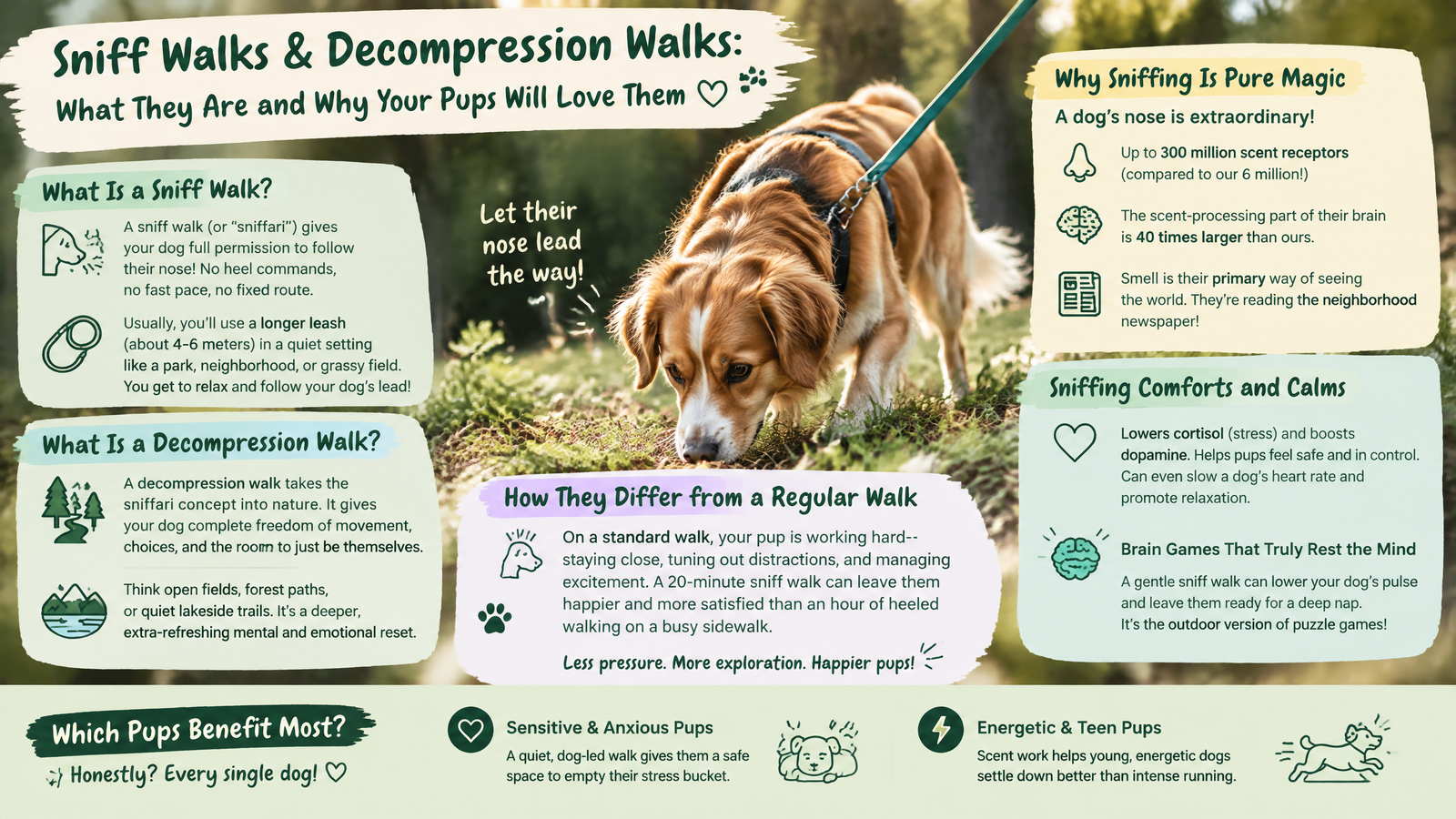
Trainers sometimes call the neighborhood version a sniffari, and the quieter off-street version a decompression walk. The names are fancier than the habit. You are mostly standing around while a dog reads the grass.
A normal walk is a job
On a short leash, a dog is managing you, traffic, other dogs, and the smell they are not allowed to finish. That is useful practice. It is also tiring in a different way from exercise. A dog can come home from a brisk mile still wound up, because the interesting part of the walk got skipped.
A sniff walk drops the heel work. You use a longer line, usually 15 to 30 feet, in a place with room. The dog chooses the clump of weeds. You wait. If they spend four minutes on one spot, that is the walk working, not the dog being stubborn.
Sniff walk or decompression walk
A sniff walk can happen on a quiet side street or the edge of a park. A decompression walk is the same idea with fewer interruptions: a field, a wide trail, a lakeside path before the joggers show up. The Wisconsin Humane Society describes decompression walks as dog-led time with room to move. That matches what people notice at home. The dog comes back looser in the shoulders.
Do not do this on a retractable leash next to cars. The long line is for open ground, and it stays in your hand. A harness is kinder than a collar if the dog still surges at the start.
Why the nose matters more than the mileage
Dogs live by smell in a way we do not. The American Kennel Club notes that dogs have something on the order of 300 million scent receptors, against about 6 million in people, and a much larger share of the brain devoted to sorting those smells. A patch of grass is a record of who passed, how recently, and whether they were intact, anxious, or in season.
Scent work also tends to slow dogs down. You will see the head drop, the breathing change, and the tail loosen. Some writers claim a neat cortisol drop and a dopamine spike from every sniff. I would not hang the habit on that. The practical version is enough: a dog who got to investigate often naps harder than a dog who was marched.
If the house is still loud after the walk, indoor puzzles cover a different itch. The notes on signs a dog is bored are useful when chewing shows up on the days you skip the slow outing.
Who gets the most out of it
Almost every dog likes a chance to sniff. A few need it more.
Reactive or easily flooded dogs. A busy sidewalk fills the day with decisions. A quiet field gives them fewer of those. It is not a cure. It is a lower-pressure hour.
Adolescent dogs who bounce off the walls after a jog. Running spends the legs. Sniffing spends the attention. Plenty of young dogs need both, on different days.
Older dogs who cannot do the old mileage. A slow loop still gives them a job that does not ask for speed.
Watch the body, not the clock. Soft eyes and a loose mouth usually mean you can stay. A stiff freeze or a hard stare at another dog means the spot was not quiet enough. Body language is easier to read when you are not also trying to hit a step count.
How to try one this week
Clip a long line to a harness. If structured walks are still a tow, sort that on a separate outing with the plan in loose-leash walking. Do not mix the two lessons in one loop.
Pick a place with grass and few surprises. An empty school field at 7 a.m. beats the dog park.
Let the first stop last. Phone in your pocket. If you narrate every sniff, you have turned it back into a class.
Leave sit and heel for the hallway. A sniff walk with a cue every ten seconds is just a normal walk with extra tangles.
Start with 15 minutes. Once or twice a week is plenty while you learn where the line snags.
On ordinary days you can still steal two minutes. Say “go sniff” at the verge, then call them on when you actually need to move. Scatter a few pieces of kibble in clean grass if the dog does not know how to slow down yet. Some dogs trot the whole first outing because they are waiting for the next instruction. The second or third time, they usually figure out the instruction is the grass.
Bring a bag. Long-line walks find every old stool in the field.
You do not need a new philosophy of dog walking. You need one outing where the lamp post is allowed to take as long as it takes.

 Most neighborhood walks are a compromise. You have a route, a time, and a dog who keeps stopping at the same lamp post. Sniff walks flip that. You still hold the leash. The dog picks the pauses.
Trainers sometimes call the neighborhood version a sniffari, and the quieter off-street version a decompression walk. The names are fancier than the habit. You are mostly standing around while a dog reads the grass.
Most neighborhood walks are a compromise. You have a route, a time, and a dog who keeps stopping at the same lamp post. Sniff walks flip that. You still hold the leash. The dog picks the pauses.
Trainers sometimes call the neighborhood version a sniffari, and the quieter off-street version a decompression walk. The names are fancier than the habit. You are mostly standing around while a dog reads the grass.