
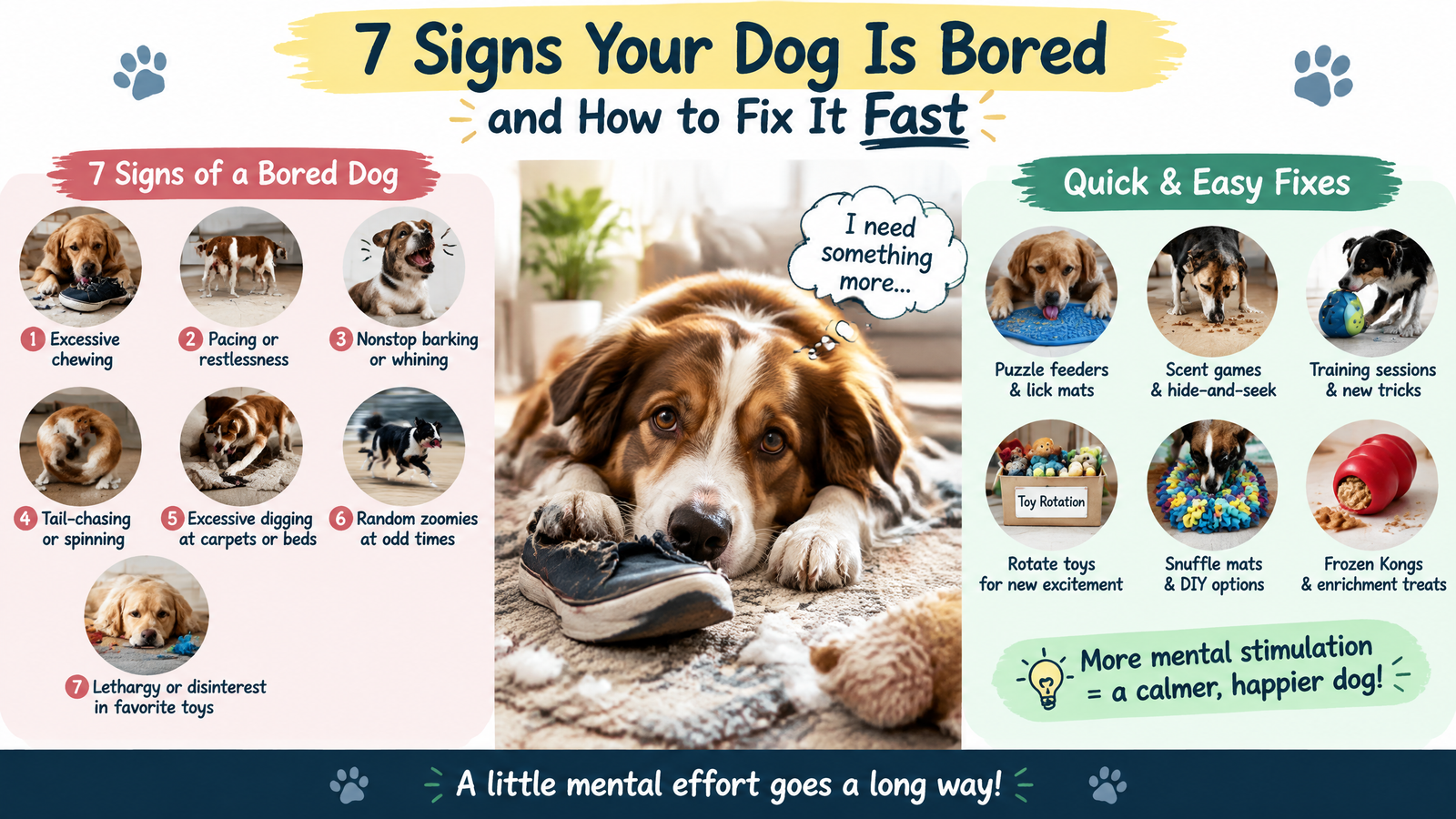
The shoe is in three pieces and the dog looks pleased. People call that naughty. Sometimes it is. Often it is a dog who finished the day at 10 a.m. and then had to invent the rest.
More walking helps some of this. It does not fix a dog whose only job is to watch you type. Mental work is cheaper than people expect, and it shows up in the house faster than another mile.
What boredom looks like at home
These signs overlap with other problems. A dog who starts destroying walls overnight needs a vet, not a puzzle toy. If the pattern is every evening, when nothing is happening, boredom is a fair guess.
Body language helps you separate frustration from fear. A loose, busy dog is a different case from a tucked, panting one.
Chewing, pacing, barking
Chewing is the obvious one. Baseboards, remote controls, the arm of the couch. The jaw has a job, so the dog assigned it.
Pacing the same line from the kitchen to the window is the indoor version of a dog walking a fence. Barking at nothing while you are in the room is often a request for a task, rather than a noise problem you can shush away.
Spinning, digging, zoomies, quitting toys
Tail chasing that shows up in a quiet house can be under-stimulation. It can also be medical, especially if you cannot interrupt it. Indoor digging at the rug usually means the yard version got cancelled.
The 8 p.m. zoomies are common in young dogs who were fine all afternoon and then dump the unused energy on the hallway. The last pattern is easy to miss, because the dog ignores every toy. That can look calm. It is often a dog who already solved the toy pile and then stopped looking.
What to change this week
You do not need a basket of new products. You need meals and ten-minute blocks to stop being free.
Feed at least one meal from a puzzle, a snuffle mat, or a muffin tin with a towel over the kibble. A lick mat with a smear of dog-safe peanut butter (no xylitol) or plain pumpkin buys 10 to 20 minutes. Raise the difficulty when the dog solves it in a minute. Gulpers do better with this than with a bowl they finish before you sit down.
Hide food after that. “Find it” in three rooms, then stop. Ten minutes of nose work tires a lot of dogs more than a second lap around the block. Teach one small thing in the same window: a hand target, or a settle on a mat. Quit while they still want the treat.
Put most toys away. Leave two out. Then swap in a third on Friday. Dogs treat the returned toy like a new one, which is slightly insulting and very useful.
Outside, trade one fast loop for a slower sniff walk. If the fast loop is a drag down the street, the pulling is its own problem. The leash plan is separate from the boredom plan, so do not try to fix both on the same block.
A week that is boring for you
Monday and Thursday: a stuffed Kong from the freezer. Tuesday: treats in the grass. Wednesday: five minutes of a new cue. Friday: a toy swap. On the weekend, one longer sniff outing. That is the whole system.
Five to fifteen minutes, twice a day, is enough to test the theory. If chewing drops within a few days, you found it. If the dog is still frantic, or if the spinning got worse, book the vet before you buy another toy.