What Your Dog’s Body Language Is Really Telling You
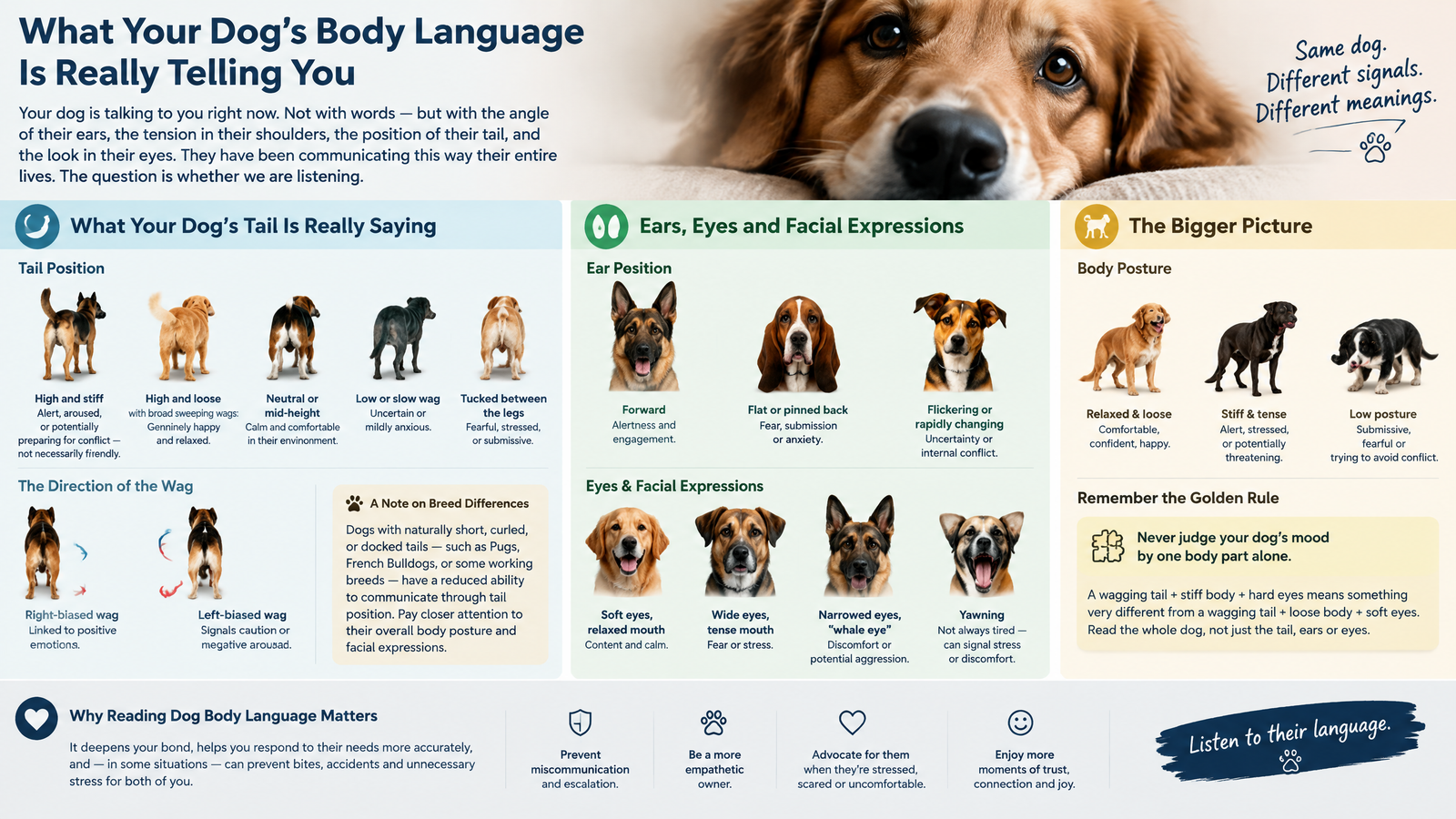
Dogs talk with the equipment they have. Ears, tail, weight shift, the set of the mouth. Most of us were taught one translation: wagging means happy. That one is wrong often enough to cause trouble.
A wag can be loose and friendly. It can also be high and tight while the dog decides whether to leave. The belly-up flop can be an invitation, or a dog trying to end the interaction. A yawn in the hallway at 10 p.m. is tired. A yawn while a child is hugging the neck is often a request for space.
Read the sentence, not one word
Texas A&M’s veterinary school makes the same point trainers repeat in class: body language is a package. PetMD says it plainly too. One body part is a clue. The combination is the message.
A high stiff tail with a still body is not the same dog as a mid-height tail sweeping while the hips wiggle. If you only watch the tail, you will miss the freeze.
People often say a dog “bit out of nowhere.” Behavior clinics usually find the earlier signals in the retelling: a lip lick, a look away, a paw lift, then a growl nobody counted. Dogster has written up that pattern. Catching the early ones is the whole skill.
Tail
Veterinary behaviorist Dr. Kelly Ballantyne, in a breakdown shared by Chewy, sorts positions roughly like this:
High and stiff: focused, maybe over-aroused. Not an automatic play invite.
High and loose, wide sweeps: comfortable, often glad to see you.
Neutral carriage: settled.
Low, slow wag: unsure.
Tucked: worried, or trying to opt out.
There is research on wag bias, rightward versus leftward, tied to approach and avoidance. Interesting in a lab. Hard to score on a sidewalk. Do not over-read a single wag direction on a Tuesday walk.
Breeds with a screw tail or a short tail, including many French Bulldogs, give you less tail to read. Use the face and the shoulders instead.
Face
Ears forward usually means the dog is locked on something. Ears pinned can be worry, or just a soft greeting in a floppy-eared dog. You have to know that dog’s normal. A Beagle’s ears do not look like a Shepherd’s when both are relaxed.
Soft eyes, a blink, a slightly open mouth: often fine. Hard stare, no blink: pause whatever you are doing. Whale eye, the white showing as the head turns away, is a common “I am done” signal. NJ Dog and plenty of trainers flag it. Stop the hug. Do not explain to the dog why the hug was friendly.
Lip licks with no food nearby, and yawns outside of sleep, show up on the AKC’s list of calming signals. A shake-off after a greeting, the wet-dog move on a dry dog, often means the moment was a lot.
The rest of the body
A relaxed dog is loose from nose to tail. BARK’s writers describe the wiggly walk you get at the door when the day went well. Weight is even. The mouth is not clamped.
The play bow is the clear one: elbows down, rear up, then a bounce. Context still matters. Some dogs bow and then get too hot. End the game when the bow disappears and the body goes still.
Worry looks smaller. Weight back, tail in, eyes off to the side. Arousal that is tipping toward defense looks bigger: weight forward, hair up on the shoulders, mouth closed, stare fixed. Stylla and other clinical write-ups call the sequence a ladder. Growling is several rungs up. If you only punish the growl, you remove the warning and keep the discomfort.
Three signals people argue about
Belly up. Loose dog, soft eyes, paw in the air: rubs are probably welcome. Stiff legs, looking away, tail clamped even while rolled: that is not a request. Stand up.
The guilty face. Ears flat and a low head after you find the trash is usually a response to your voice, not a confession. Dogs offer that look when a person sounds angry, whether or not they did the thing.
The freeze. Petting, and the dog goes still. Hands off. A freeze is information. Pushing past it is how polite dogs learn that polite did not work.
Practice on a boring evening
Watch the dog asleep, then watch them when the doorbell goes, then watch them when a guest reaches over the head. You want the baseline before you interpret the spike.
Kids can learn two pictures: loose and wiggly versus still and tight. That is enough to keep most greetings safer. If the tight picture shows up on walks, a slower sniff walk is a better reset than another lap at a heel. If the tightness shows up as chewing the couch, look at boredom too. Not every problem is fear. Not every problem is manners.
You will misread something. Everyone does. The correction is to give the dog an exit and try again later, not to insist your first translation was right.
 Dogs talk with the equipment they have. Ears, tail, weight shift, the set of the mouth. Most of us were taught one translation: wagging means happy. That one is wrong often enough to cause trouble.
A wag can be loose and friendly. It can also be high and tight while the dog decides whether to leave. The belly-up flop can be an invitation, or a dog trying to end the interaction. A yawn in the hallway at 10 p.m. is tired. A yawn while a child is hugging the neck is often a request for space.
Dogs talk with the equipment they have. Ears, tail, weight shift, the set of the mouth. Most of us were taught one translation: wagging means happy. That one is wrong often enough to cause trouble.
A wag can be loose and friendly. It can also be high and tight while the dog decides whether to leave. The belly-up flop can be an invitation, or a dog trying to end the interaction. A yawn in the hallway at 10 p.m. is tired. A yawn while a child is hugging the neck is often a request for space.