A Labrador is the dog people recommend when they mean “friendly.” That part is usually true. The other part is a strong dog with a mouth, a food drive, and joints that complain if the dog gets heavy.
Use this to decide if the breed fits the week you actually have. It will not describe every Lab.
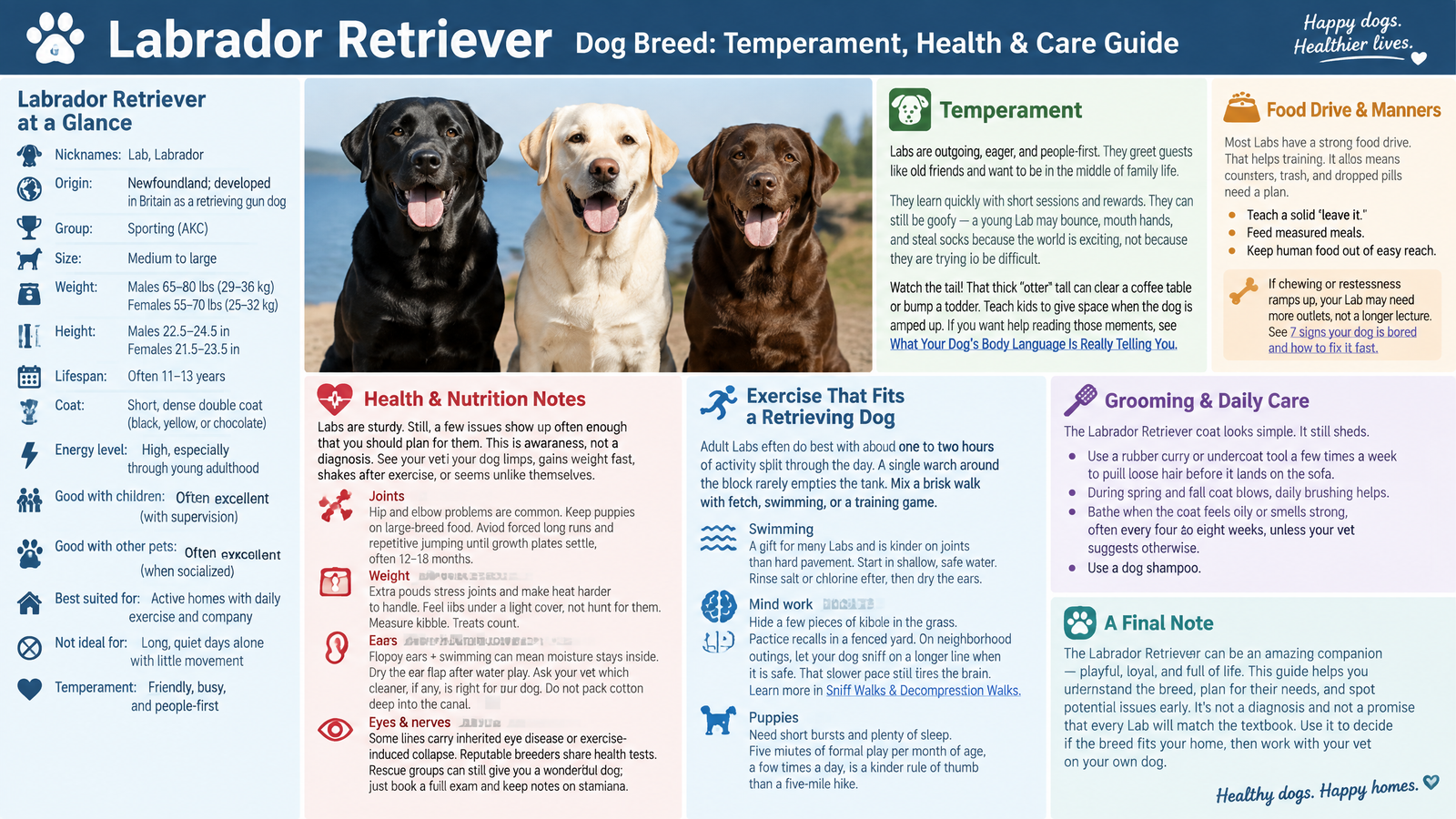
Snapshot
- Origin: Newfoundland stock, shaped in Britain as a retrieving gundog
- Group: Sporting
- Weight: males often 65 to 80 lb, females often 55 to 70 lb
- Height: males about 22.5 to 24.5 inches, females about 21.5 to 23.5 inches
- Lifespan: often 11 to 13 years
- Coat: short double coat, black, yellow, or chocolate
- Energy: high through young adulthood
- Poor fit: long empty days and no plan for the trash can
Temperament
Most Labs greet people like the person was invited. That makes them lousy guard dogs and easy house guests if you like company. They were bred to work with a handler, so short sessions with food or a toy usually land. Young ones still mouth hands and steal socks. That is the breed being a retriever, not a moral failure.
The tail is a tool and a hazard. It clears low tables and whacks kids. Give the dog space when the tail is going, or move the table.
Food drive is the training gift and the kitchen problem. Teach a leave-it before you need it for a dropped pill. Measure meals. A Lab who “just looks hungry” will eat until the bag is a problem. If the chewing ramps up in a quiet house, check boredom before you add another lecture.
Reading the dog gets easier if you watch more than the wag. The notes on body language cover the stiff version of a greeting, which is not the same as the wiggly one.
Health and food
Hips and elbows are the headline inherited issues. Keep puppies on a large-breed formula. Skip long forced runs and repetitive jumping until a vet is happy with growth, often somewhere around 12 to 18 months. Weight is the lever you control. You should feel ribs under a light fat cover. Treats count.
Floppy ears plus swimming means moisture. Dry the flap. Ask the clinic before you pour cleaner down the canal. Some lines carry eye disease or exercise-induced collapse. A breeder should be able to show health tests. A rescue Lab can still be the right dog. Budget for a full exam and watch how they recover from play.
Vaccine visits and limp checks go better with a little homework. Prep for the vet visit is the unglamorous version.
Exercise and coat
Adults often need one to two hours, split. One lap of the block does not empty a young Lab. Fetch, swimming, and training games do more than marching. Start swim sessions in shallow water you trust, then rinse and dry ears.
Nose work counts. A sniff walk on a long line, where it is safe, spends attention without more impact on the joints. Puppies need short bursts and sleep. A few minutes of formal play per month of age, repeated, beats a hike.
The coat looks easy and still sheds. A rubber curry a few times a week, daily in spring and fall, keeps the sofa closer to its original color. Bath when they smell, not on a schedule you found on a chart. Dog shampoo. Nails before they click. Teeth, even if “brushing” is ten seconds of dog toothpaste.
Hands on the ribs and the tail base during grooming are how you find a new lump. A sudden limp is a vet call, not a rest day you forget about.
Training priorities
Name and a recall you have paid for. Loose leash. A sit for greetings so jumping does not become the hello. Leave it and drop it, because the mouth collects the walk. A mat while you cook. Keep sessions short enough that you end first.
Socializing means pairing new floors and sounds with space, not dragging a puppy through a crowd to “get it over with.”
If you are choosing between the two popular retrievers, the Golden guide is the coat and cancer conversation. Labs shed too, just differently, and they are often more food-obsessed. Meet adult dogs of both before you decide on a color.
The fit
Get a Lab if you will be outside most days and you want the dog in the room. Wait if your plan is a crate through the workday and a Saturday hike. A bored Lab invents a job. The job is often the bin.
An adult rescue shows you the real engine. A 16-week-old hides it. Ask about food stealing and what the dog does on a rainy afternoon. That answer matters more than the puppy photo.