
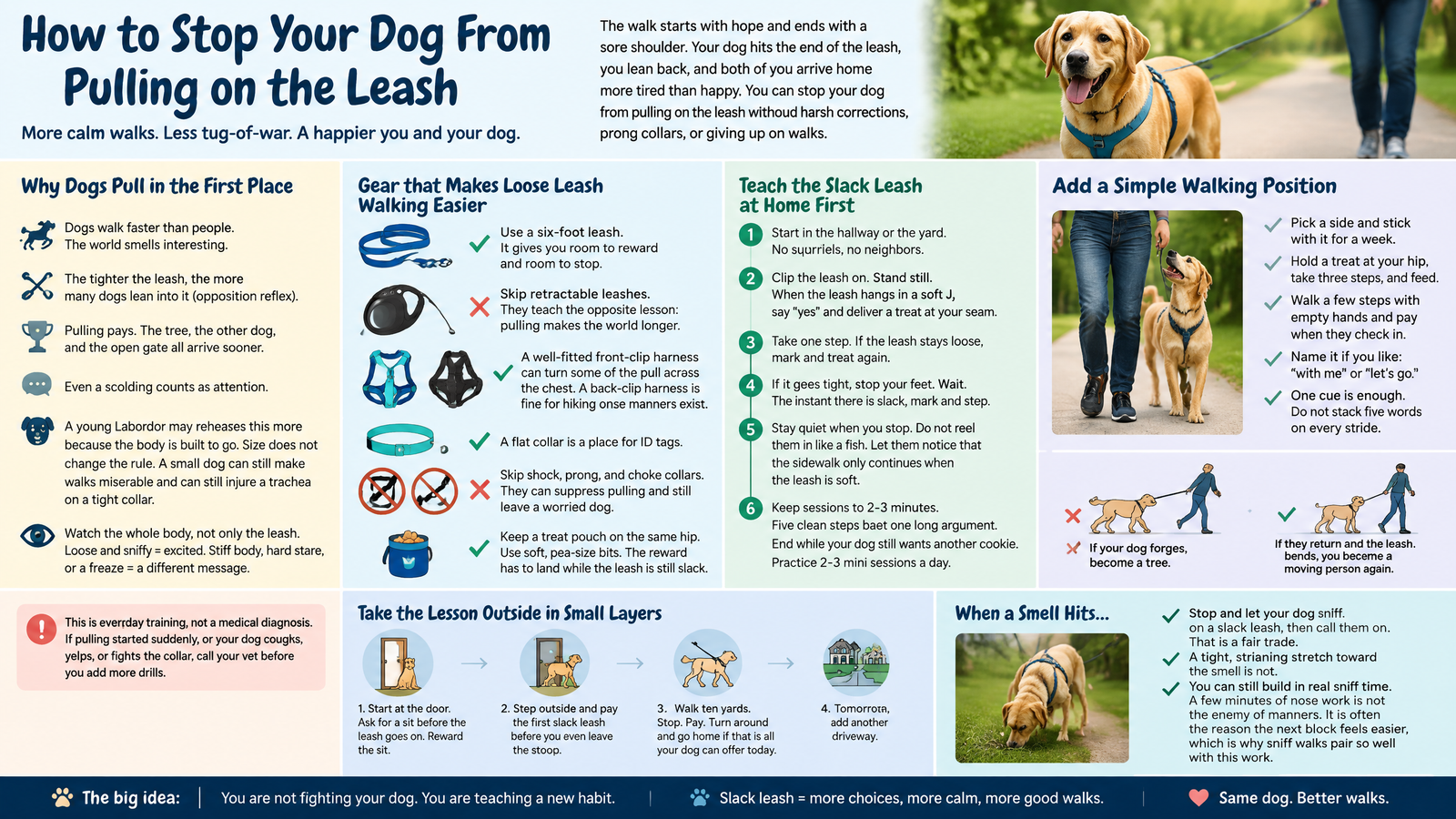
The walk starts with hope and ends with a sore shoulder. Your dog hits the end of the leash, you lean back, and both of you arrive home more tired than happy. You can stop your dog from pulling on the leash without harsh corrections, prong collars, or giving up on walks.
Pulling is not a personality problem. It is a skill your dog has practiced because it works. Forward motion is the prize. Change what the tight leash earns, and the walk can become a conversation instead of a tug-of-war. This is everyday training, not a medical diagnosis. If pulling started suddenly, or your dog coughs, yelps, or fights the collar, call your vet before you add more drills.
Why dogs pull in the first place
Dogs walk faster than people. The world smells interesting. The tighter the leash, the more many dogs lean into it. Opposition reflex is real enough on the sidewalk: pressure on the neck or chest often makes a dog push harder, not softer.
Pulling also pays. The tree, the other dog, and the open gate all arrive sooner when your dog tows you there. Even a scolding counts as attention. A young Labrador Retriever may rehearse this more often because the body is built to go. Size does not change the rule. A small dog can still make walks miserable and can still injure a trachea on a tight collar.
Watch the whole body, not only the leash. A loose, sniffy dog who forges ahead is usually excited. A stiff body, a hard stare, or a sudden freeze is a different message. Those details live in what your dog’s body language is really telling you.
Gear that makes loose leash walking easier
A six-foot leash gives you room to reward and room to stop. Retractable leashes teach the opposite lesson: pulling makes the world longer. Save the long line for a fenced field or a dedicated recall session, not a busy sidewalk.
A well-fitted front-clip harness can turn some of the pull across the chest instead of straight against your arm. A back-clip harness is fine for hiking once manners exist. A flat collar is a place for ID tags. If your dog gasps, retches, or makes a honking sound when the leash tightens, switch the clip off the neck and talk to your vet.
Skip tools that promise instant manners through pain. Shock, prong, and choke collars can suppress pulling and still leave a worried dog. You want a walk your dog can think through, not a walk they endure.
Keep a treat pouch on the same hip every time. Soft, pea-size bits work better than biscuits that take ten chews. The reward has to land while the leash is still slack.
Teach the slack leash at home first
Do not start this lesson on the busiest block in town. Start in the hallway or the yard, with no squirrels and no neighbors.
Clip the leash on. Stand still. The moment the leash hangs in a soft J, say “yes” and deliver a treat at your seam, next to your left or right leg. Take one step. If the leash stays loose, mark and treat again. If it goes tight, stop your feet. Wait. The instant there is slack, mark and step.
Your dog will test the old rule. That is fair. The old rule worked for months. Stay quiet when you stop. Do not reel them in like a fish. Let them notice that the sidewalk only continues when the leash is soft.
Keep sessions to two or three minutes. Five clean steps beat one long argument. End while your dog still wants another cookie. Practice two or three mini sessions a day instead of one frustrated loop around the block.
Add a simple walking position
Pick a side and stick with it for a week. You do not need a formal heel. You need your dog near you often enough that you can pay them.
Hold a treat at your hip, take three steps, and feed. Then walk a few steps with empty hands and pay when they check in. Name it if you like: “with me” or “let’s go.” One cue is enough. Do not stack five words on every stride.
If your dog forges, become a tree. If they return and the leash bends, you become a moving person again. That contrast is the whole lesson.
Take the lesson outside in small layers
The front walk is harder than the hallway. Treat it as a new classroom, not a failure of the last one.
Start at the door. Ask for a sit before the leash goes on, the same polite pause you would use when you stop your dog from jumping on people. Reward the sit. Then step outside and pay the first slack leash before you even leave the stoop.
Walk ten yards. Stop. Pay. Turn around and go home if that is all your dog can offer today. A short, successful outing beats a long, crooked one. Tomorrow, add another driveway.
When a smell hits, you have a choice. You can stop and let your dog sniff on a slack leash, then call them on. That is a fair trade. A tight, straining stretch toward the smell is not. You can still build in real sniff time. A few minutes of nose work is not the enemy of manners. It is often the reason the next block feels easier, which is why sniff walks pair so well with this work.
Change only one thing at a time. New street, or new dog across the road, or a dropped treat on the ground. Not all three at once.
Fix the habits that keep pulling alive
Inconsistent rules undo good work. If you allow a drag to the park and then demand a heel on the way home, your dog learns that pulling still opens the good part of the walk. Pick a standard and use it for the whole outing, even when you are late.
Do not wait for the Saturday group walk to start training. A quiet Tuesday sidewalk is a better classroom. Busy trails make most dogs too excited to think.
Watch for a burst of extra pulling right after you start stopping. That flare is common. Stay the course for several days. Reward the first clean stretch of slack leash like it is a huge win, because it is.
If your dog only pulls when they have had no outlet, add a short play or training game before you clip on. A restless dog is harder to coach. Restlessness is not the same as the patterns in 7 signs your dog is bored, but a little mental work still helps the slack leash show up.
Skip the treat if your dog is too amped to chew. Scatter three pieces on the grass beside you. The head goes down. The pull loses its target. Then walk again.
Rain and mud make everyone rush. If you usually hurry home and let the leash go tight, your dog learns that weather cancels manners. Pause on the mat, wipe paws, and keep the same slack-leash rule you use on dry days. The landing-zone idea in how to care for your dog after a rainy walk gives you a place to reset before anyone skids down the hall.
When pulling needs extra help
Some dogs pull because the collar hurts and then they get more frantic, not less. Others pair pulling with lunging, growling, or a hard stare at other dogs. That is not a manners project anymore.
Book a vet visit if pulling started overnight, if your dog coughs after walks, if the neck seems sore, or if they come up lame. You can use the same slow handling you would use when you prepare your dog for a vet visit. Ask for a certified trainer or veterinary behaviorist if home practice stalls for weeks, if anyone in the home feels unsafe, or if your dog cannot pass another dog without exploding.
Seniors and tiny dogs still deserve a soft leash. A pull that once looked cute can injure an older neck or a collapsing trachea. Keep sessions even shorter and use a harness that does not ride into the armpits.
Puppies can learn this. So can adult rescues. The method does not change. The timeline does. An adult who has towed people for years needs more quiet repetitions, not a louder cue.
A calm next step
You can stop your dog from pulling on the leash by changing what the tight leash earns. Use a six-foot leash and a comfortable harness. Pay the slack. Stop when it vanishes. Then grow the walk ten yards at a time.
Tonight, clip on in the hallway. Mark three soft steps. Tomorrow, take those steps to the sidewalk and come home while it is still going well. Loose leash walking is a habit you build in small, repeatable pieces, the same way you build every other kind piece of care.